|
Card Sort |

|

|

|
||
|
Card Sort |
|
|

|

|
Card Sort
|
Card Sort |
|
|
|
||
|
Card Sort |
|
|
|
|
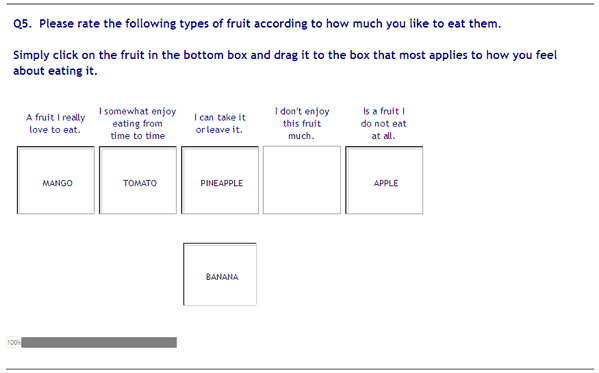
Card sort is an interactive drag and drop question that is very engaging of the respondent and ensures that the stimuli are being paid attention to.
It is a very useful question type for replacing the number of grids that are used in surveys.
Example of a Card Sort question.
Creating this question.
First enter the question text -
 Enter the question text by clicking on the Question Text icon. A rich text editor box appears where you type your question. You have full rich text control over the question formatting.
 : Enter the instruction text by clicking on the Instruction icon.A rich text editor box appears where you type your instructions. You have full rich text control over the question formatting.
 : In the questionnaire, the following question appears in a different screen (default) or appears under this question (click ticked box to turn off Page Break).
 Check to make the question mandatory for the respondent to complete.
Designing the Answer boxes.
The image below contains the entries that created the above example. To add
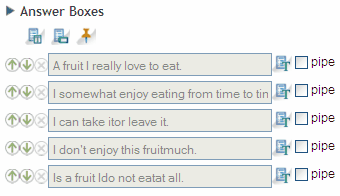
 Click to add another Answer Box.
 Click to add a different name than the default.

 Click to enter and format the description for the destination box.
 Check if you wish to use this option to pipe the cards put into this box to another question – example – “Are brands that I would consider using.”
 Click to move the item up, down or delete.
Note that they are all rich text boxes which enables you to create any sort of answer box you desire - including images such as smiley faces.
Other options that can be set for answer boxes include;
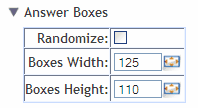
 Check to randomize the order of the destination boxes (answer boxes) for the cards to go to.
 Enter the parameters to describe the size of the answer boxes in width and height.
Adding the stimuli - the cards.
The image below shows the parameters that were used to create the above example. Note that the cards conform to all the question types with regard to the types of cards you can use - text, images or rich text. In this example we have used text.
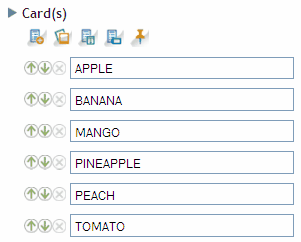
Adding Cards:
 Add Card Text: Click to add another card to be dragged to an answer box.
 Add Card Images: Click on this icon to open the image library and choose the images you wish to include as possible answers.
 Add Card Rich Text: Click on this icon to include a rich text answer. Click on the rich text editor icon to open the rich text editor and include any formatted type of question you like.
 Allows the user to name each answer variable which will be used in the data extract.
 Fix Position: Lock an answer in position so that it maintains the same positional order despite answer randomization. Clicking on this option causes a selector box to appear beside each answer. Check the boxes next to each answer that you do not wish to rotate.
Click to move the item up, down or delete.
Other options available to the cards:
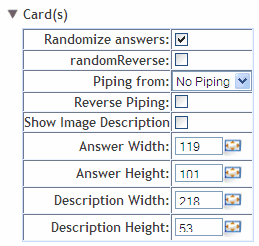
Randomize answers: Check the box to randomize the order of the answers for each respondent. Note that this option is often used with the Fix Position option to exclude options like Other and None from being included in the randomization.
Random Reverse: Check this to cause the order of a answer series to be reversed for 50% of the respondents. This is often used for rating scales were the order of presentation can have an impact on the result.
Piping from: Used to populate the answer fields with the answers selected by a respondent at an earlier question.
Reverse piping populates the answer fields with all the answers from a previous question that were NOT selected.
To use simply select from the drop-down the previous question that contains the answers you wish piped.
NOTE: To construct a more sophisticated piping regime based on several previous questions use a Pipe question type.
Show Image Description: Will cause the description of an image to be displayed when image answer types are used. Note that the image description needs to have been created for the image in the image library.
Answer Width:
Answer Height:
Description Width:
Description Height:
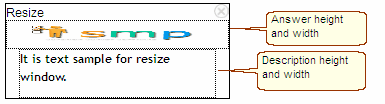
These options all allow the user to define the height and width of the answer values whether they are images or text. This can be achieved by either typing the exact number of pixels desired for the option being edited or by clicking on the box image which causes the folling pop up to appear. Once this pop up appears the size of the answer and/or description of an image can be set by dragging the pop u boxes to the desired widths.